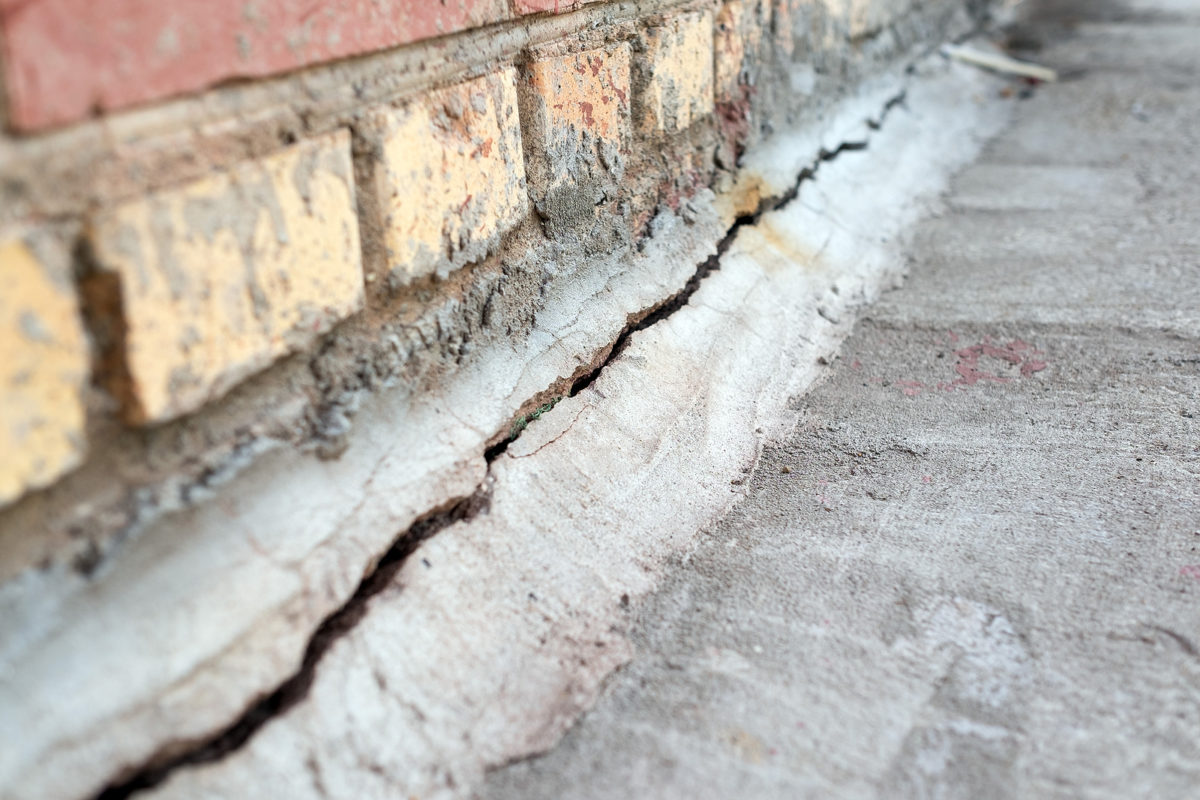
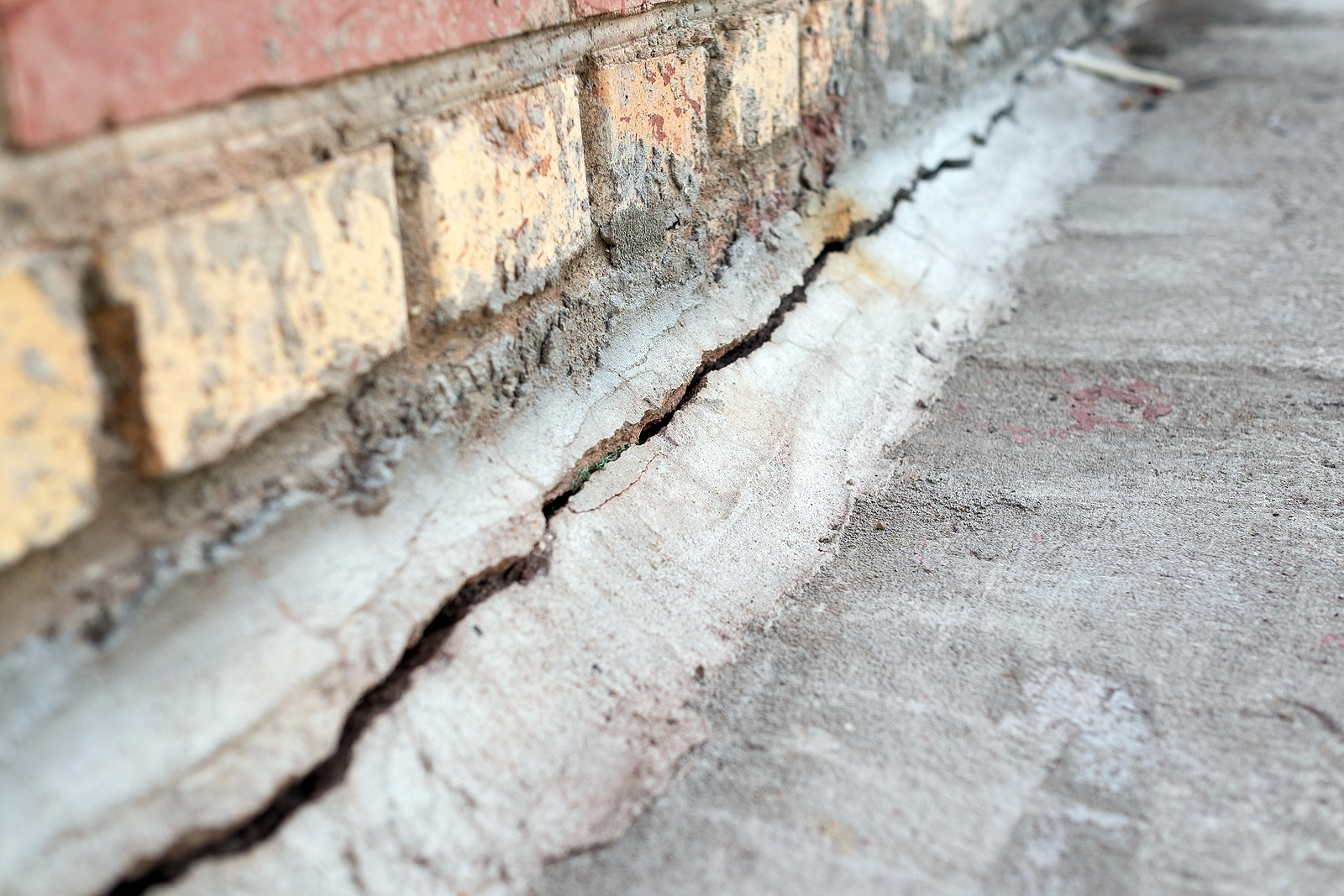
Uh-oh – not the foundation! What to look for, who to call and what you’ll pay

“The support upon which something rests,” is how Merriam Webster Dictionary defines ‘foundation.’ Think about that for a minute. Your home rests on its foundation, which, when functioning properly, provides structural stability, safety and value to the home.

If it’s not in peak condition, you may end up paying a fortune to repair it and/or the damage to the home that has occurred because of it.

So, how do you know if there might be a problem with the foundation of your home? Read on and we’ll share with you what we learned from the experts.

Cracks in the foundation

Not all cracks indicate a foundation problem. The following types of cracks may be signs of trouble:

  • A crack that is one-quarter of an inch or more
  • Cracks that resemble stair steps located between cement blocks
  • Cracks that run horizontally
  • A crack that runs diagonally at a 30 to 75-degree angle. Although it may be thin, it “… will likely be wider at one end than the other,” according to the experts at EdenStructural.com.

Windows and doors may indicate a foundation problem

Check your windows and doors for any cracks that may be above them. Check the upper corners of these areas for cracks that start there and extend upward to the ceiling. While these cracks may just indicate settling, it they measure more than one-quarter of an inch wide, they might indicate problems with the foundation.

Sticking windows or door is often caused by humidity. A shifting foundation, however, may be the culprit.

If the problem occurs in only one door or window there is likely no cause for concern. If, on the other hand, you’ve found other signs of a foundation problem, seek help from a professional as soon as possible.

What are the walls saying?

Warped, bowing and bending basement walls are signs of dangerous structural issues. “Everything else in the home is resting- directly or indirectly- on top of your basement walls.  If one of them weakens, it compromises the stability of your entire structure,” according to the pros at Acculevel.com.

Who to call for help with foundation problems

Foundation repair or even the diagnosis of a problem isn’t a DIY project. While a structural engineer can certainly help with the problem, you might also look into interviewing foundation repair contractors.

“… look for one who is certified, has glowing reviews, and offers a great warranty,” cautions D.P. Taylor at Angi.com.

Ask the repair person if he or she is certified by the National Foundation Repair Association and “… the International Code Council Evaluation Services (ICC-ES), a nonprofit organization,” according to Taylor.

In fact, the pros at Foundation Repair Network caution consumers to not “… do business with a contractor that does not have their foundation repair methods evaluated by ICC-ES.” This ensures that the building materials used “…meet code compliance.”

To round up contractors to interview, ask your colleagues, neighbors, family and friends who they would recommend. Check Nextdoor.com and Yelp.com in your area for reviews and consult the Better Business Bureau to learn of any complaints against the contractors and/or engineers. Ensure that whomever you hire is licensed and insured and, ask for references. Then, finally, check those references.

How much does foundation repair cost?

“The cost of foundation repair ultimately depends on the type of foundation used, the size of the home, soil stability, and more,” according to Nick P. Cellucci at Angi.com (formerly Angi’s List).

The site estimates a national average cost of $4,913, and a range of between $2,154 to $7,737. They offer a calculator to find the cost of foundation repair in many areas across the country. Just enter your ZIP code at Angi.com.

Katie Flannery and Evelyn Auer at BobVila.com state that “Foundation repair cost ranges from $2,010 to $7,717, with the national average at $4,714.”

You may also want to visit the Foundation Repair Network’s website for their ballpark estimate of costs.

Whatever you do, if you suspect a problem, don’t put off hiring a pro to inspect the foundation.
 

Here’s what you need to know about private mortgage insurance (PMI)

Most American homebuyers at the turn of the 20th century were forced to pony up 50 percent of the home’s appraised value to get a mortgage. Needless to say, most low- and middle-income folks’ version of the American Dream didn’t include homeownership.

Today, it’s not at all uncommon for cash-strapped homebuyers to put down far less than the “standard” 20 percent of the home’s appraised value – but the privilege comes with a price in the form of monthly private mortgage insurance (PMI) premiums.

What is PMI?

PMI (or MIP, short for “mortgage insurance premium,” when dealing with an FHA loan) is a policy that covers the lender if the borrower defaults on the loan. Although the borrower derives no direct benefit from the policy (other than that low down payment), he or she pays the premium.

Since borrowers with less than 20 percent equity in the home are considered high risk, PMI is mandatory, according to Fannie Mae and Freddy Mac.

The price you’ll pay

“The average cost of private mortgage insurance, or PMI, for a conventional home loan ranges from 0.58% to 1.86% of the original loan amount per year,” according to the editors at NerdWallet.com, citing Genworth Mortgage Insurance, Ginnie Mae and the Urban Institute.

With an FHA loan, the borrower on a 30-year loan, with a 10 percent down payment is required to pay an upfront fee of 1.75 percent of the loan amount and then between 1.3 percent and 1.55 percent of the loan amount annually.

Most lenders allow the annual fee to be paid monthly, and it’s tacked on to your mortgage payment.

When can I cancel PMI? 

If you took out a conventional loan after July 29, 1999, you can request a cancellation of PMI once your loan-to-value ratio (LTV) reaches 80 percent.

By law, however, the lender must cancel PMI when the ratio is scheduled to reach 78 percent, according to the original amortization schedule, or when the loan reaches its midpoint, regardless of LTV.

So, how do you know when you’ve reached any of the aforementioned milestones? Divide your current loan balance by the current appraised value of the home. If you suspect that your home’s value has increased or you’ve paid the principle down significantly it may be worth it to pay to have the home appraised.

Can I cancel MIP on a FHA loan?

The Federal Housing Administration (FHA) calls its mortgage insurance MIP, for Mortgage Insurance Premium.

Ridding yourself of the MIP payment on a FHA-backed loan is a bit tougher than it is with a conventional loan. If you put 10 percent to 19 percent down on the home you must wait 11 years to be relieved of the MIP requirement.

If you pay less than 10 percent down, the MIP payment remains for the life of the loan.

Now, this only applies to borrowers with FHA-backed loans granted after June 3, 2013. If you have an earlier loan, the MIP termination requirements are different.

With a 15-year FHA-backed loan, you can get rid of MIP when the loan reaches 78 percent LTV. With a 30-year mortgage MIP will also terminate when the LTV reaches 78 percent if you’ve been paying the premium for at least 60 months.

By the way, FHA bases the home’s value on their last appraisal, not its current market value. Typically, the value used to calculate LTV will be what the home was worth when you purchased it.

Additional ways to ditch mortgage insurance 

Change your LTV ratio

Changing either side of the LTV ratio may result in the cancellation of mortgage insurance. Either make extra payments, or a lump sum payment to bring down the “loan” portion of the ratio or make improvements to the home or wait for area values to rise to increase the “value” side of the ratio.

The home improvement projects that add the most value to the home are, unfortunately, the most expensive. A minor kitchen remodel will get you the most bang for your buck according to Remodeling magazine’s Cost vs. Value Survey.

Although the national average cost for this project is $28,279, it will add $20,125 in home value.

Yes, that’s a big chunk of change, but if you make this improvement you may raise the value of the home enough to be rid of the PMI payment every month. As a bonus, when you sell the home you’ll make more money than you would have otherwise, and recoup 71.2 percent of the cost of the addition.

Refinance

If the above seems too costly or time consuming, consider refinancing the home. This option isn’t ideal for all borrowers so have your financial advisor crunch the numbers for you.

Keep in mind that a new loan will require closing costs, so your financial advisor will need to take those into account as well.

While it may seem unfair to be forced to pay for an insurance policy that only benefits someone else, PMI does provide an advantage to the cash-poor borrower—the ability to qualify for a home loan.

Lowball offer on your home?

Once upon a time, not too terribly long ago, homebuyers wouldn’t even dream of submitting an offer for less than what a home was listed.

That, however, is so last year. We are moving into a time where it appears that buyers will have more homes from which to choose, more time to shop for a home and more leeway in asking for concessions. They will also not hesitate to submit an offer lower than asking price.

Lowball offers, those that are 10% or more off the list price, aren’t common. Yet. That doesn’t mean, however, that you won’t receive one when your home is on the market.

It’s insulting, right? It takes a lot of nerve, as some sellers claim.

Others feel a sense of panic.

When homes begin to sit on the market longer than they did in the previous hot sellers’ market, some homeowners may feel a sense of desperation when faced with a very low offer. They may suffer from that gnawing feeling that anything is better than nothing.

Let’s take a look at how you can deal with such an offer without being sucked into common knee-jerk emotional responses.

Take a deep breath

As mentioned earlier, you may not get a lowball offer. But being prepared for one, emotionally at least, will help you deal with it should it come to pass.

There are two primary reasons that some homebuyers may submit a low offer on your home.

First, there are all those “news” stories claiming that home prices are falling, rapidly and dramatically. While that may be true in some markets, it is untrue in most. Misinformation rules the day when it comes to the current housing market.

But the average person in the market to buy a home doesn’t know that.

The truth is, “… home prices in August [were] still 13.5% higher than August 2021,” according to CNBC.com’s Diana Olick, citing a report from property data giant CoreLogic.

Then, understand that the buyer is most likely not intentionally insulting your home or you, as the seller. Many buyers treat the homebuying process as a business transaction, which it is. Others are adept at haggling over prices in other areas of their lives and aren’t about to stop when it comes to such a huge purchase.

In other words, put yourself in their shoes. Appreciate that they made an offer at all and the valiant effort put forth to get the home at a bargain price.

You don’t have to accept the offer

How you respond to the offer depends a lot on the type of market we are in. In a market such as the one we’ve seen in the past few years, with multiple offers on homes, often over asking price, and homes selling as soon as they hit the market, it makes no sense to waste time on a lowball offer.

In slower markets, however, you may want to entertain the offer by counteroffering at a price that’s more palatable to you. You might also consider countering any concessions the buyer has requested, such as paying for a percentage of the buyers closing costs.

Or, you may want to ignore the offer altogether and that’s okay as well. The buyer’s offer will simply expire on the date specified in the purchase agreement.

If, on the other hand, the offer is acceptable to you, in both price and terms, you will sign it and we’ll send it back to the buyer’s agent. We now have an executed contract with clearly defined tasks and time limits. It’s time to take the next step towards closing.

Financial aspects to consider before deciding to rent out your house

Sometimes it makes financial sense to hang on to your old home when you buy another. Of course, you’ll want to talk it over first with your financial advisor, but if he or she crunches the numbers and they come up in your favor, you may consider renting out the home.

In fact, renting it out to someone else may be the perfect way to keep ownership while the home gains value. And, as you’ve no doubt read in the media, rents are at record highs.

Here are a few financial aspect to think about before making the leap to becoming a landlord.

Can I afford it?

After speaking with your financial advisor, it’s time to visit a lender. A loan officer can give you a definitive answer on how much you can afford to spend on your next home.

Although it’s not likely in the current housing market, take into account that there may be periods of time when the rental sits vacant. Consider as well that you may end up with tenants who either don’t pay on time or just quit paying.

At that point you’ll have two mortgage payments on your hands. Can you afford that?

Again, run the figures by your financial advisor before making a decision.

Look into the costs of renting out the home

The easiest course of action for the first-time landlord is to hire a property manager to take care of the business end of the rental. This may be the most expensive aspect of renting out the home.

Property manager fees vary widely and often depend on what you want them to do. “As a baseline, expect to pay a typical residential property management firm between 8 – 12% of the monthly rental value of the property, plus expenses,” claim the pros at AllPropertyManagement.com.

Then, there may be an increase in your homeowner insurance, which will, in turn, raise your mortgage payment.

“… renting out the home changes the owner’s status from primary occupant to investor,” warns Margarette Burnette at Bankrate.com.

“As a result, it costs more money to insure the home with a special landlord insurance policy. According to the Insurance Information Institute, the premium is about 25 percent more than with typical homeowners insurance,” she concludes.

Maintaining the home for tenants may be a bit more expensive than it was when you lived in the home. While we often overlook things in our own homes, tenants expect and typically have a right to certain repairs.

Landlords receive from their tenants, on average, six repair-related calls  a year, according to the experts at MoneyGeek.com.

“… a lot of problems that need to be addressed are the same 10 repairs, over and over again,” according to Brandon Turner, real estate investor and podcaster. He goes on to list, at BiggerPockets.com, the most common repairs that landlords are called on to make:

  1. Major appliance breakdown
  2. Water leaks
  3. Faucets dripping
  4. Lack of hot water
  5. Insects and rodents
  6. Inoperable garbage disposal
  7. Leaky, clogged or running toilet
  8. Furnace in need of repair
  9. Inoperable smoke detectors
  10. HVAC problems
  11. Electrical problems
  12. Drywall repair

Finally, consider the legal fees you will incur as a landlord. These may run the gamut, including fees for help with constructing rental applications and leases, deal with evictions and other aspects of owning a rental. All of these costs can add up quickly.

For the financially sound, renting out their home when they purchase another can be a brilliant financial strategy. Pursue professional legal and financial advice to ensure that you don’t lose money in the end.

3 critters that invade homes in fall and winter

Ants on the porch or insects in the garden are annoying but tolerable summer staples. With cooling weather, however, many pests go on a hunt for a nice, warm place to hunker down over the fall and winter.

Unfortunately, our homes beckon these critters. There are ways, however, to discourage them from taking up residence.

1. Roaches

“Cockroaches can’t migrate during the colder months, so they need to find a warm hiding spot to survive,” according to Jack Andersen at CockroachZone.com. In your garden, they will hibernate under leaf piles, rocks and other areas.

The problem for these outdoor roaches is that they are unable to regulate their internal temperature. Many perish during periods when the air temperature is 15 degrees Fahrenheit or colder.

Obviously, the warmth emanating from our homes acts as a beacon, drawing roaches inside.

How do they get in? Andersen offers up the following possibilities:

  • Cracks in walls
  • Vents
  • Chimney
  • Pipes and drains

He recommends keeping the home clear of moisture, such as from leaks, since it’s “… one of the top attractants of cockroaches.” They’ll also be attracted by crumbs, food spills and grease on the stovetop, food in the pantry that isn’t securely closed and even dirty dishes left in the sink overnight.

Discourage these pests from taking up residence in the home by cleaning up any debris behind your appliances, such as the refrigerator and stove. Smaller appliances, such as the coffee maker, microwave oven and toaster may harbor crumbs and, thus, cockroaches. Clean the areas behind and beneath these appliances.

Finally, seal any cracks in the walls, around plumbing pipes and baseboards.

2. Mice

Mice are the rodents that you’ll most likely find in your home during fall and winter. Ridding your home of an infestation is important because they do so much damage. They’ll gnaw through paperwork, wires and even clothing.

Their saliva, urine and droppings can cause asthma attacks in sensitive individuals and children are their most likely bite victims.

In their mission to escape cold temperatures, mice can squeeze into incredibly small areas to gain access to your home. “Mice can fit through a crack or hole one-fourth of an inch or larger – or about the width of a pencil,” according to the pros at Terminix.com.

They also offer tips on how to dissuade these critters from making themselves at home:

  • Store stacks of firewood well away from the home and up off the ground.
  • Leaf piles are attractive to mice, so discard those that are near the home’s foundation.
  • Remember the “one-fourth of an inch” access warning and seal all holes and cracks of that size or larger in your home. “Large holes or cracks should be stuffed with steel wool or wire mesh before sealing with caulk or foam, otherwise rodents could chew through and enter,” warn the Terminix pest control experts.
  • Weather strip the bottom of doors, especially the door from the garage into the home.
  • As with roaches, keep the home free from food crumbs and other debris.
  • If you see a mouse in your home, call a pest control company immediately. Don’t give it time to breed or cause destruction.

3. Spiders

In fall, spiders begin the hunt for a mate. That, in turn, can work up quite the appetite.

“To discourage them from settling in your house, remove webs promptly, and turn off exterior lights at night. Lights attract insects, which in turn attract spiders searching for food,” suggests Andréana Lefton at BobVila.com.

Another solution to keeping these critters out of the home is to “Mind the Gaps and Seal the Cracks,” according to Lefton. The fewer insects in the home, the fewer spiders you’ll encounter.

3 Things to consider before going FSBO

“Frankly, I don’t think a Realtor does much that I can’t do myself,” a New Jersey homeowner tells CBS News.

It’s understandable that many real estate consumers feel this way; after all, the only part of the process that they see is an agent pounding a sign into the yard, hanging a lockbox on the door and then sitting around for a couple of hours during open houses, right?

Surely it can’t be that hard to sell a house. And just think of the money you’ll save if you sell it yourself.

Lots of jobs look easy to outsiders. But, before you head to hunt for real estate contracts, before you join one of those nifty For-Sale-By-Owner (FSBO) websites, read on for three things you should consider.

 1. Can you get the price right?

Every year, the National Association of REALTORS ® (NAR) surveys FSBOs about the types of problems they encountered when selling their homes.

Thirteen percent of them said that setting the right price was very challenging.

Of course it is. Determining the market value of a home isn’t something someone learns overnight – it takes years of experience and neighborhood knowledge to get it right.

Because crunching these numbers is something we do back at the office and not in front of the public, it seldom ends up on the short list of “things a real estate agent can do for me.”

A home should typically be priced at or close to its market value. So, how does a homeowner with no real estate experience come up with the appropriate listing price?

You’ll need access to recent home sales in your area and for that you’ll need a real estate agent. Sure, you can jump onto Zillow and get one of their lame “Zestimates,” but since they don’t have access to many of our MLS statistics their valuations are pretty much worthless.

In fact, a few years ago the CEO of Zillow relied on his company’s Zestimate, known in the industry as an automated valuation model (AVM),  when pricing his Seattle home.

The home was priced at the Zestimate (of $1.75 million) and eventually sold, for 40% less, or $1.05 million.

Think of the Multiple Listing Service as the Kelly Blue Book of the real estate world. Just as you wouldn’t dream of putting your car on the market without learning what similar cars have actually sold for recently, so should you not rely on an AVM or take a wild guess about your home’s current market value.

 2. Getting the word out

While the best listing agents wear many hats and perform a variety of jobs for their clients, the number one most important job is marketing. Gone are the days when an ad in the Sunday paper was all that was needed to generate interest in a home. And, as valuable as an MLS listing is to let real estate buyer’s agents know your home is for sale, it too is not enough.

Today, marketing a home for sale requires multiple platforms and, since most homebuyers begin their search for a home on the Internet, online marketing is critical. A homeowner lacking in marketing expertise may leave valuable equity on the table with a DIY marketing plan.

 3. That pesky legal paperwork

Completing the contracts and other paperwork is one of the most challenging aspects of the home sale for most FSBOs, according to the NAR survey.

Hey, we don’t blame them for being confused. Real estate contracts are written by attorneys and anyone without real estate sales experience is bound to think they were written in Greek.

From the offer to purchase to the addendum, disclosures and amendments, the average real estate deal is loaded with legal paperwork.

Do you know what to look for in the purchase agreement? Do you know how to structure your response to a potential buyer to your benefit? What form will you use if you need to make changes or additions?

There are far too many places to run afoul of your best interests when it comes to the paperwork. Why take the chance?

Selling a home when you don’t do so for a living is complicated. While it’s not impossible to do so without a real estate agent, it isn’t wise. Not if you hope to make the most amount of money possible in the shortest amount of time. We’re happy to speak more with you about this – give us a call.

The costs and benefits of staging a home for sale

What if we told you that you could turn $402 in cleaning supplies into $2,024 extra in the sale of your home, just by cleaning your house?

A home improvement study performed by a real estate portal revealed just how much you can net just by performing the basics.

Imagine how much more you’d realize if you went beyond just decluttering and cleaning. Staging the home is the next logical step once you have it clean and sparkling.

The psychology of homebuyers is complicated but two things a seller can count on include:

  1. They want a home they can move right in to without hiring a cleaning crew first.
  2. They want to picture themselves living in the home, surrounded by their belongings.

These feelings are so pervasive among buyers that 63% of potential homebuyers surveyed by Maritz, a marketing research firm, said they would be willing to pay more for a home they perceive to be turn-key.

Staging the home meets both of the goals for the buyer.

What is home staging?

Staging a home for sale creates the best first impression possible, from the moment a potential buyer comes in the front door.

A home stager’s goal is multi-pronged:

  • Make the home appear well cared-for
  • Create a light and bright atmosphere
  • Showcase the lifestyle the home offers
  • Depersonalize the home just enough to allow buyers to envision how they can personalize it to their liking.

Home stagers are experts at drawing the eye to the positive aspects of the home while downplaying those that are less attractive.

The costs of staging a home

The cost of hiring a professional home staging service varies widely, depending on the scope of the project. A vacant home costs more to stage than one that is occupied and furnished. A large home will cost more to stage than a small home. The price varies by region as well.

Fixr.com claims that the “national average cost” will run you $1,500 with the average range between $1,000 and $3,000. The lowest cost they found was $200 and the high end a whopping $10,000.

Then there is the research published at HomeAdvisor.com. They’ve found that home sellers can expect to pay between $750 and $2,829, with an average cost of $1,731.

The site also offers a staging calculator that you can set to get local costs.

Since some stagers charge by the month after the initial staging, the cost in the long run could be higher.

There are ways to get around the high cost of home staging

Staging is almost a must for luxury homes. Low- and mid-priced homeowners, however, can get a bit creative in their staging choices.

First, consider paying a professional stager for a consultation. It’s worth the money spent to pick the brains of an expert.

Then, take his or her tips and make staging a DIY project.

If you’re on a tight budget, consider staging only key rooms, such as the entryway, living room and kitchen.

DIY staging doesn’t have to be expensive, however. Use the furniture you already own and then raid friends’ and relatives’ attics and storage containers to find accessories.

You’ll find DIY home staging tips online at familyhandyman.com, realsimple.com and hgtv.com.

Benefits of home staging

Two thousand dollars. That’s roughly the return you’ll realize when you sell your staged home. The more you invest in staging, the higher the return.

How much higher? According to an industry survey (Home Staging Resource), homes that are staged tend to sell for between 6% and 25% more than non-staged homes.

Keep this in mind before you dismiss staging because of the cost.

Since homes are staying on the market longer than in months past, you’ll be happy to hear that staged homes sell faster than homes that aren’t staged, according to the president of the International Association of Home Staging Professionals, (IAHSP), Barb Scwartz.

Her research finds that homes staged by an IAHSP member sell 20% quicker than homes that aren’t staged.

Remember, homebuyers are willing to pay more for homes they perceive as move-in ready.

That first impression of your home can make the difference in whether potential buyers decide to look beyond what they see at the front door and even how much they are willing to pay for the home.


Concerned about home security? What to look for when buying a home

Depending upon where you live in the U.S., home security may be your biggest concern when buying a house. Urban homes with security features are hot sellers and insurance on these homes is typically discounted.

There are many home security systems available, including alarm systems and cameras that make houses less attractive to crooks and more attractive to buyers.

First, look for basic home security features when house hunting

High-tech home security systems are only one aspect of home safety. Basic home security includes some common-sense strategies that make your home a tougher target for criminals. Consider these home security tips when viewing homes:

  • All exterior doors should have deadbolts, including the door leading to an attached garage. Security professionals recommend that the deadbolt you purchase meets the American National Standards Institute (ANSI) grade 1 testing standards.
  • Doors to the exterior of the home and the garage should be 1 ¾ inches thick.
  • Doors should be attached to frames with hinge screws that are at least two and a half to three inches long.
  • Doorways should be well-lit.
  • Exterior doors should be solid wood or reinforced with steel.
  • If window security bars are used, they should be easily removable in case of fire.
  • The front door should be visible from the street.
  • Hedges should be trimmed to below the windowsills.
  • Check all the window locks to ensure that they work properly.

Home security systems

A few years ago, researchers at Rutgers University pored over five years of statistics and found that a burglar alarm in the home will decrease the residents’ chances of break-ins.

Home security systems come in many forms and at most price points. The most complicated systems alert security companies when security alarms go off or when suspicious activity is detected on security cameras.

Other systems sound local alarms when a door or window is breached, alerting residents and neighbors.

Some home security systems are smartphone-integrated and will text or phone homeowners when alarms are triggered or security cameras detect motion.

If a home security system isn’t in your budget, consider a dummy system. Some include decoy cameras that resemble real ones. Another recommended deterrent is a motion-activated security light, or several placed strategically around your property.

Get a security check-up on that home you have your eye on

Police officers can offer a wealth of information and advice when it comes to your safety and home security. Contact the local police department for information on how many calls they answer in the neighborhood during a typical month. Find out about the typical response time in the neighborhood for both police and fire fighters.

Check the National Sex Offender Registry database to find out if there is a sexual predator living nearby.

Security consultants and police officers suggest that the aim of home security isn’t to necessarily burglar-proof your home, but to make it appear less attractive to burglars than other homes on the street and to slow down an intruder that is determined to gain entry.

Some police departments will assess the security of a home as a public service. These security checks go over the basics of home security and provide you with the tools you need to get started on creating your own home security system.

If you prefer a DIY home security evaluation, check out this home safety checklist at Safewise.com.

Open house? How to prepare your home for the big day

The open house has been a part of home selling for more than 100 years, according to the National Association of REALTORS® (NAR).

Fast forward to today and, although still a tool that many real estate agents use, the open house has decreased in popularity. We can thank the internet for that. With online access to video tours, virtual tours and 3-D floor plans, many homebuyers decide which homes to view online, not by driving around and visiting open houses on weekends.

According to Home Buyers and Sellers Generational Trends, the NAR’s annual survey, when asked about the first step taken during the home buying process, only 2% of respondents visited an open house.

While more than half of homebuyers found the home they eventually purchased online, only 4% purchased a home they found with a “yard/open house” sign.

With a changing market, however, an open house just might be what helps sell your home. Let’s take a look at ways to ready the home for the big day.

Let folks know

Yes, your real estate agent will get the word out about your open house, but who better to spread the word among the neighbors than you? Ensure you visit them and extend an invitation to the open house.

Ask if they know anyone who might like to live in the neighborhood and urge them to bring those folks along on open house day.

Don’t forget people you work with. Ask your real estate agent for a handful of fliers and pass them out at work.

The four-legged family members

The best thing to do with pets during the open house is to find someplace for them to go. If you can’t take them with you when you leave for the day, can you keep them at a family member or friend’s home? If not, how about a day at the groomers or doggy daycare?

Remove all evidence of the furry friends, such as crates, bowls and toys and attend to any pet-related repairs.

Secure what needs securing

We’ve found that most open house attendees are honest folks. But, there is the occasional exception. For this reason, it’s important to secure certain items in the home, such as weapons, prescription drugs and valuables.

Taking these items off-premise is the best way to assure that they’re secure.

Don’t leave any financial information, such as bank statements, investment information, blank checks, credit or other bank cards in plain view or in drawers, unless the drawer can be locked.

Do it yourself or hire someone, but get it done

Clean your house. Keeping a clean house is probably the most tedious task of selling a home, but cleaning it for the open house is critical.

We aren’t talking tidying up here, but cleaning deeply, until the house is immaculate. Professional house cleaners often suggest that you come up with a system and one that we like starts at the front door. From there, you work your way around the home from left to right or right to left, whichever you choose.

As you move through the home, start each new area by cleaning from top to bottom, from the ceiling to the floor. This way you don’t miss any spots that are commonly missed such as that area where the ceiling meets the wall, the baseboards and the light fixtures.

Then, turn your attention to the garage. A two-car garage is in demand with homebuyers but that same garage offering obvious storage options is something folks clamor after.

Clean and declutter the space and then highlight any storage options it offers.

The open house is your home’s chance to grab local homebuyers’ attention. Ensure that it puts its best ‘foot’ forward for a quick sale.

Landscape your way to additional home value

landscaping

Yes, Mom, money does sometimes grow on trees. The experts at the Appraisal Institute say that anything you do to better the appearance of the outside of the home will increase its value. In fact, updating the home’s landscaping alone may increase the value up to 11% according to a Michigan State University study.

This is, most likely, a direct result of another study’s findings (National Association of Landscape Professionals). This survey found that 84% of Americans feel that how a particular home is landscaped would impact their decision to buy it.

So, what do these professionals consider “good” landscaping?

Good landscaping is ‘sophisticated’

While the sophistication of a landscape design is something that is hard to put into words for most consumers, like art, they know it when they see it.

The study defines a sophisticated landscape as one that includes a balance of large deciduous trees, evergreen plants, annual color plants and colored hardscape. The latter includes all non-plant features, such as decorative brick, pavers and gravel.

The study found that a home with only a lawn in the landscape, valued at $150,000, can gain $8,250 to $19,050 more in value with an upgraded, sophisticated landscape.

By the way, The Michigan State University study’s respondents ranked a landscape’s sophistication as most important when considering the perceived value of a home.

Size does matter

For homes located in a region of the country where trees take significantly longer to grow tall, a large tree may add more to the home’s value than smaller trees. “A mature tree can often have an appraised value of between $1,000 and $10,000,” according to experts at the Council of Tree and Landscape Appraisers.

Other studies, such as one conducted by the Arbor Day Foundation, claim that any trees on the property may add up to 15 percent additional value to a home.

As an added bonus, a young healthy tree offers the cooling equivalent of 10 room-size air conditioners running 20 hours a day, according to the U.S. Department of Agriculture.

Mix it up a bit

Achieving diversity isn’t a worthy goal only for the human race, but for your home’s landscaping as well.

For the most bang from your landscaping buck, consider following the Michigan State University study findings by planting annual color plants and adding colored hardscape to the yard.

Annual plants are those that complete their lives in one season. They can be planted anywhere, but look especially striking in beds, borders and containers. Typically planted in the spring and summer, some annuals to consider include vinca (Vinca spp.), zinnia (Zinnia spp.) and sweet pea (Lathyrus odoratus).

Plant shorter annuals toward the front of the beds and taller, or climbers, toward the middle and rear.

Whatever you do, don’t go minimalist

Minimalist landscape schemes that contain only small plants actually detract from a home’s value, according to the Michigan study. If you’re on a tight budget and can’t afford an entire landscape makeover, consider adding at least one of the more important aspects of a sophisticated landscape design.

Since plant size is second in value to sophisticated design, consider adding at least one tall tree and sprinkling the landscape with splashes of annual color. The Arbor Day Foundation offers a handy calculator on its website that allows users to choose a type and size of tree to determine how much value it will add to the home.